















You might know your dog's typical sleeping position inside out. For years, they curled up in their bed every evening, tucking their nose toward their tail to fall asleep. But suddenly, things look very different. Your dog is lying on their side, stretching their front and back legs out wide, and suddenly taking up much more space than they used to.
First of all, a new sleeping position is no cause for concern. Dogs sleep in many different positions and change them depending on the situation and their comfort level. In a large study on the sleeping behavior of young dogs, for example, more than 84 percent of owners reported seeing their dog sleeping stretched out on their side, while nearly 64 percent also observed a curled-up sleeping position. Different sleeping postures are therefore completely normal.
It becomes more interesting when a sleeping position you have been accustomed to for years changes significantly. This can be due to mundane reasons like room temperature. However, it may also be that your dog is simply more comfortable lying stretched out or wants to relieve pressure on certain parts of their body in a different way.
In this article, we explain why your dog suddenly prefers to sleep stretched out rather than curled up, what role temperature, musculature, and the musculoskeletal system can play in this, and how you can tell if their current sleeping place still meets their needs. We will also look at why enough space and a suitable lying surface are important for restful periods of sleep, and when a changed sleeping position should be clarified by a veterinarian.
Why dogs change their sleeping position
Dogs do not sleep exactly the same way every night. Sometimes they lie curled up, sometimes on their side, on their stomach, or with their legs stretched out wide. Which position is comfortable at any given moment depends on various factors. These include the environment, the temperature, the sense of security, and last but not least, physical comfort. Professionally vetted information on sleeping positions therefore points out that the chosen position often simply depends on the dog's current preference.
The curled-up position has a very practical advantage. A dog reduces their body surface area and can thus better retain heat. This behavior has evolutionary roots and is particularly sensible at lower temperatures. If your dog, on the other hand, stretches their legs and body out wide, more surface area is available to them, and they can adopt a completely different body posture.
This is precisely why the change alone is not a warning sign. The deciding factor is not whether your dog sleeps curled up or stretched out, but whether they are lying in a relaxed manner and can change between different positions without any problems.
From a physiotherapeutic perspective, having sufficient space is actually relevant. Dogs should have the opportunity to stretch out completely and change their lying position without restrictions. In veterinary rehabilitation, it is noted that permanently forced, highly flexed resting positions can be uncomfortable and, especially in dogs with limitations, can contribute to stiffness when getting up.
Therefore, it is worth looking at the overall picture when there is a new sleeping habit. If your dog sleeps deeply and calmly while stretched out, gets up afterwards without any problems, and moves normally, they may have simply discovered a new comfortable position for themselves. If, on the other hand, they constantly have to change their position, seem restless when lying down, or have trouble getting up after sleeping, you should take a closer look.
A changed sleeping position is not a diagnosis. However, it can be a valuable everyday observation if it occurs together with other changes in movement, rest, or well-being.
What role temperature and the season can play
Before you suspect a physical problem behind a new sleeping position, it is worth looking at something quite mundane: the temperature. Dogs also use their body posture for heat regulation. If your dog curls up tightly, they reduce the body surface area through which heat can be lost. The curled-up sleeping position can therefore help to maintain body heat.
When lying stretched out, the situation is different. Legs and body are further apart, and your dog takes up more space overall. Especially at higher temperatures, you may therefore observe that they lie on their side in a long posture more frequently or additionally seek out a cooler surface. Some dogs even specifically switch between different sleeping places during the day. In the morning, the soft bed is popular; in the afternoon, the cool tiles are suddenly preferred.
Therefore, you should always view a changed sleeping position in the context of the environment. Has the weather changed? Is the heating turned on? Has the dog bed been moved to a warmer spot? Or does your dog lie stretched out more often after physical activity than during a quiet phase?
Especially in September, such changes can be particularly noticeable. Warm days and already cooler nights alternate. Your dog can therefore sleep curled up one day and fully stretched out the next without there being anything unusual behind it.
A sleeping position alone does not allow for a reliable assessment of your dog's state of health. It is much more telling whether they sleep in a relaxed manner, can change their position without problems, and move normally after getting up.
This is precisely why a good sleeping place should give your dog options. They should neither be forced to curl up because the lying surface is too small, nor should a highly insulating bed be their only option for rest. Comfort also means that your dog can decide for themselves which position feels comfortable at the moment.
What muscles, joints, and mobility have to do with the sleeping position
Besides temperature, the musculoskeletal system can also influence how your dog prefers to lie. While sleeping, they spend a longer time in the same or a similar position. In doing so, pressure and body weight act on certain areas. Depending on how your dog lies, joints are bent or stretched, and different parts of the body are burdened.
This does not mean that sleeping stretched out indicates joint problems. Many completely healthy dogs sleep stretched out for long periods on a regular basis. A new sleeping position becomes interesting primarily when it occurs together with other changes.
Perhaps you notice that your dog not only sleeps differently but also takes longer to get up. They might turn around multiple times before lying down, constantly change position during a resting phase, or suddenly avoid a previously popular sleeping place. Changes in lying down, getting up, and choosing a comfortable resting position can be signs of pain or limitations in dogs.
This is precisely why your knowledge of normal behavior is so valuable. A dog that has always slept on its side with legs stretched out wide does not, by itself, provide any particular indication. However, if a long-standing habit changes and, at the same time, stiffness, reduced desire to move, or difficulties getting up occur, the musculoskeletal system should be considered. Changes in body posture can be associated with pain or weakness, among other things.
The surface can also make a difference. International guidelines on pain management in animals point out that a softly padded surface can support comfort, and lying on hard or cold surfaces for a long time can be uncomfortable, especially in painful conditions.
Therefore, observe not only how your dog sleeps but also how they get into and out of that position. Do they lie down smoothly? Can they turn around without difficulty? Do they stand up afterwards without problems? These small sequences of movement often provide more information than the sleeping position itself.
A suddenly preferred stretched-out posture, therefore, does not necessarily mean that something is wrong. Together with other changes, however, it can be a reason to look more closely and to seek veterinary advice if abnormalities persist.
How to tell if your dog is truly comfortable
A dog that is lying comfortably does not necessarily have to sleep in the same position for hours. Changing positions is part of normal sleeping behavior. The decisive factor is rather whether your dog can settle down in a relaxed manner and obviously enjoys using their sleeping place.
Observe what happens before your dog falls asleep quite consciously. Do they lie down and find a comfortable position after a short time? Or do they turn around repeatedly, stand up again, and try somewhere else? The size of the available sleeping place also plays an important role. If your dog now prefers to sleep stretched out, their bed should offer them this possibility. If their head, legs, or hindquarters regularly hang over the edge, the lying surface may simply be too small for their preferred sleeping position.
Equally interesting is the behavior after sleeping. If your dog gets up smoothly, stretches briefly, and then walks off normally, there is much to suggest that they were lying well. If, on the other hand, they take a noticeably long time to straighten up, seem regularly stiff after waking up, or change their lying place particularly frequently at night, you should take a closer look.
The surface also deserves attention. Very thin cushions can be compressed significantly under body weight, so that your dog is ultimately almost lying on the floor. An extremely soft mat, on the other hand, is not automatically the better choice either. A good sleeping place should be comfortable and at the same time offer enough stability so that the body is supported.
Also pay attention to which place your dog chooses voluntarily. If they keep leaving their bed to lie fully stretched out on the carpet, this may be an indication that they simply have more space there. If, on the other hand, they are constantly seeking out the tiles, their bed might be too warm for them. These small decisions often tell you more about their needs than the sleeping position alone.
If, in addition to sleeping behavior, mobility, activity, or general well-being change, the cause should be clarified by a veterinarian. A suitable dog bed can improve lying comfort but cannot diagnose or treat physical ailments.
How you can adapt the sleeping place to your dog's needs
If your dog suddenly prefers to sleep stretched out, you don't have to train them out of this position. On the contrary: their sleeping place should be based on their needs as much as possible and leave them enough freedom to change between different positions.
The first point is therefore size. Your dog should be able to lie on their side completely on their lying surface and stretch out their front and back legs. When in doubt, measure your dog in a stretched-out position and plan for enough extra space. Especially with young dogs or animals whose bodies are still changing, a bed bought earlier may simply have become too small at some point.
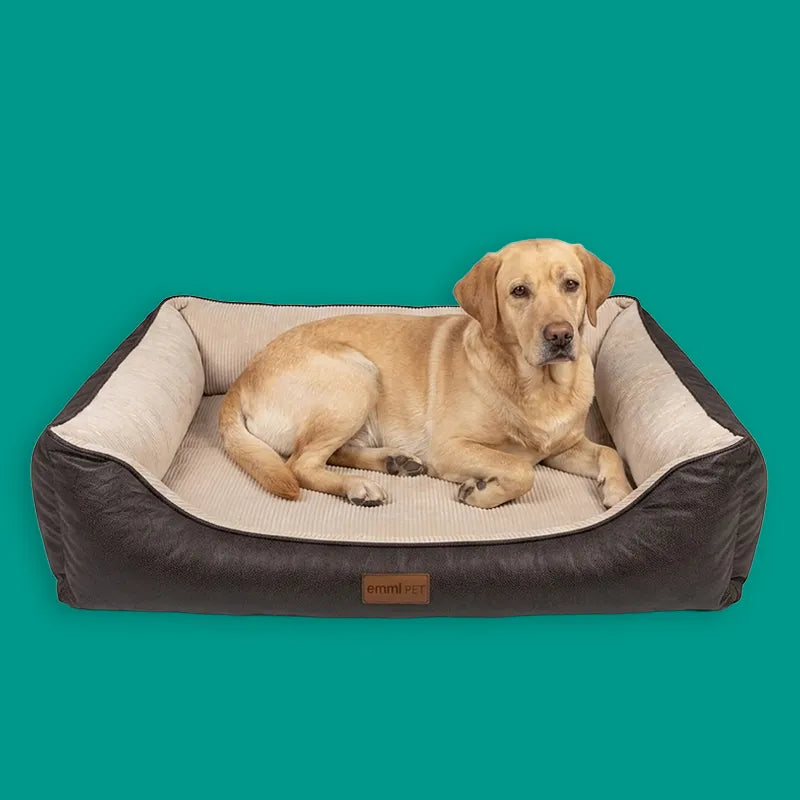
Besides that, the nature of the lying surface plays an important role. Here, our emmi-PET orthopedic dog bed can be a sensible way to offer your dog a comfortable and supportive place to rest. Orthopedic lying surfaces are designed to distribute body weight as evenly as possible and to support the body while lying down. This can be especially comfortable if your dog rests for many hours a day or now prefers stretched-out sleeping positions more frequently.
You should not only consider an orthopedic dog bed when your dog already has joint problems. A good sleeping place is first and foremost exactly that: a place for the most comfortable and restful periods of sleep possible. Even young, active, and healthy dogs can benefit from a sufficiently large and supportive lying surface.
The location is also part of it. Place the bed as much as possible in a place where your dog likes to rest. Even the highest-quality dog bed is of little use if it stands in a corner that your dog does not like because of drafts, heat, restlessness, or a lack of proximity to you. Some dogs even need several resting places so that they can choose depending on temperature and time of day.
The fact that your dog suddenly prefers to sleep stretched out rather than curled up does not have to mean anything worrying at all. Perhaps they are warmer, perhaps their preferred sleeping position has changed, or they simply enjoy taking up more space now. The crucial thing is that their sleeping place should be allowed to grow with their needs. Therefore, observe not only their sleeping position but also how relaxed they are lying, how often they change places, and how they walk after getting up. With enough space, a comfortable lying surface, and a place of rest where your dog truly feels at home, you create good conditions for exactly what sleep is intended for: recovery, regeneration, and new energy for the next day you spend together.